- Tel: +972-54-5376124
- Fax: +972-77-3457370
- E-mail: sales@testview.co.il

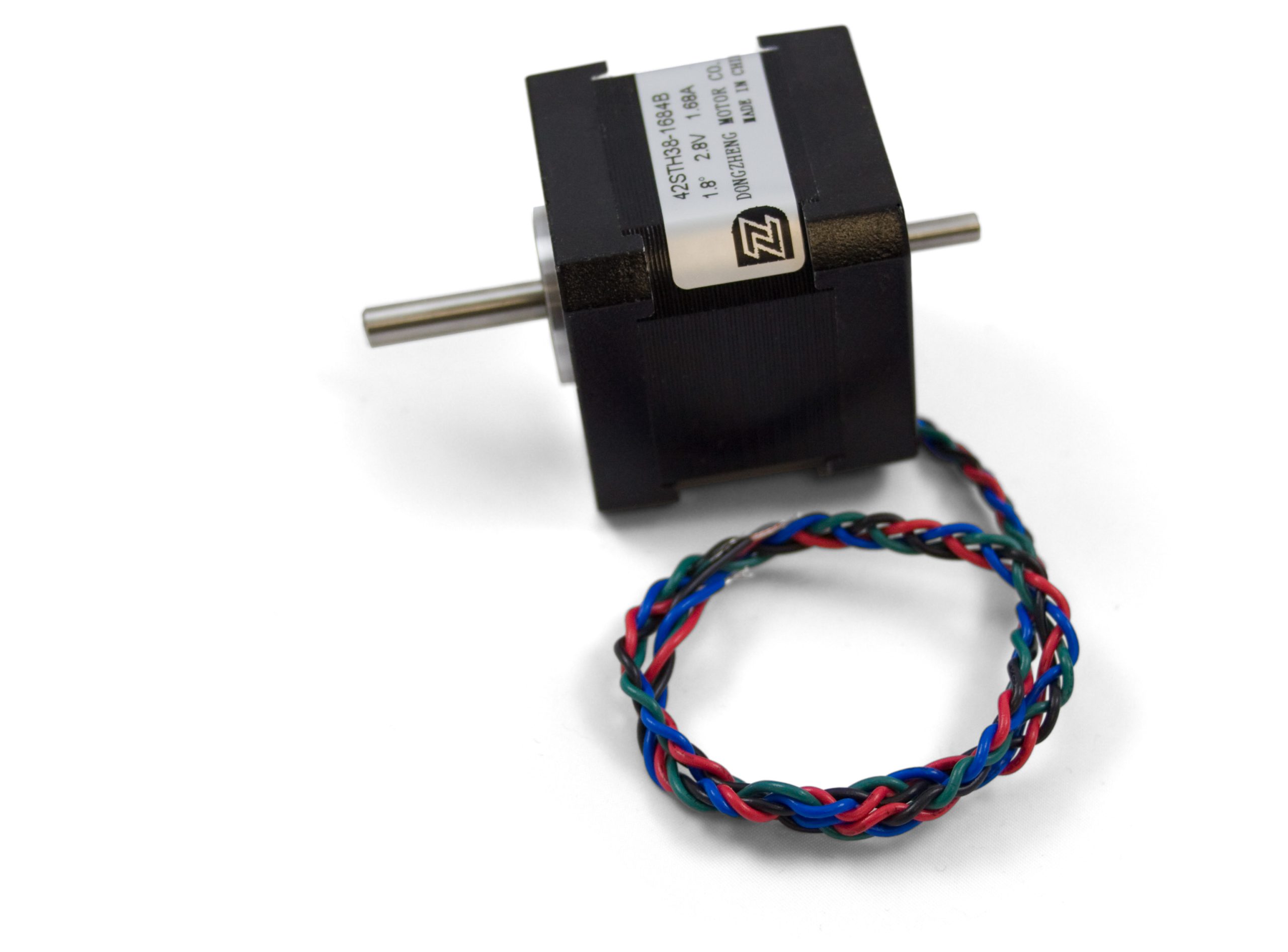



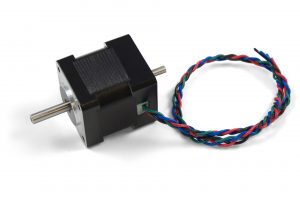
This NEMA-17 motor generates 3.6 Kg-cm of holding torque at 1.7 Amps. It comes with the rear shaft exposed, so you can mount an encoder or shaft coupler. See the “Compatible Products” tab for a complete list of attachments.
When connected to a 1067 – PhidgetStepper Bipolar HC, the 3324 has a maximum speed of 4130 RPM. See the “Compatible Products” tab for wiring details.
This motor must be controlled by a constant current or chopper drive controller. You can find a list of suitable controllers on the Compatible Productstab. There you will also find compatible attachments such as encoders, mounting hardware, and transmission hardware.
| Connecting the motor directly to a power supply will destroy the motor and void the warranty. If you want to check your motor make sure it is connected to a constant current / chopper drive controller. |
| Motor Properties | |
|---|---|
| Motor Type | Bipolar Stepper |
| Manufacturer Part Number | 42STH38-1684B |
| Step Angle | 1.8?° |
| Step Accuracy | ?± 5 % |
| Holding Torque | 3.6 kg?·cm |
| Rated Torque | 3.3 kg?·cm |
| Maximum Speed (w/1067 Motor Controller) | 4130 RPM |
| Acceleration at Max Speed (w/1067 Motor Controller) | 1E+06 1/16 steps/sec?² |
| Electrical Properties | |
| Recommended Voltage | 12 V DC |
| Rated Current | 1.7 A |
| Coil Resistance | 1.7 ?© |
| Phase Inductance | 3.2 mH |
| Physical Properties | |
| Shaft Diameter | 5 mm |
| Rear Shaft Diameter | 3.9 mm |
| Mounting Plate Size | NEMA – 17 |
| Weight | 289 g |
| Number of Leads | 4 |
| Wire Length | 300 mm |
This motor must be controlled by a stepper motor controller. This diagram shows how to connect the motor wires to the controller to produce a clockwise rotation in the stepper motor when increasing position. To wire for counter-clockwise rotation when increasing position, reverse the red and blue wires.
Note: Make sure to unplug the power cord from the motor controller before switching wires around.
The following stepper controllers can be used to drive this motor:
| Product | Controller Properties | Electrical Properties | ||
|---|---|---|---|---|
| Part Number | Motor Position Resolution | Stepper Velocity Resolution | Stepper Velocity Max | Available Current per Coil Max |
| 1067_0B | 1⁄16 Step (40-Bit Signed) | 1 1/16 steps/sec | 250000 1/16 steps/sec | 4 A |
| STC1000_0 | 1⁄16 Step (40-Bit Signed) | 1 1/16 steps/sec | 115000 1/16 steps/sec | 4 A |
The rear shaft of this motor can be equipped with an encoder for applications where you need to keep track of the exact position, velocity, or acceleration of the motor. The mounting holes on the back of this motor are compatible with the following encoders:
| Product | Encoder Properties | ||
|---|---|---|---|
| Part Number | Output Circuit Type | Encoder Resolution | Encoder Speed Max |
| 3531_0 | Push-Pull (Single-Ended) | 300 CPR | 6000 RPM |
If you need to connect the main shaft of this motor to the shaft of another device, you can use a shaft coupler:
| Product | Physical Properties | |||
|---|---|---|---|---|
| Part Number | Inner Diameter | Material | Coupling Rated Torque | Coupling Rated Speed |
| 3421_0 | 5 mm | Aluminium | 4.1 kg?·cm | 10000 RPM |
| 3425_0 | 5 mm | Aluminium | 60.7 kg?·cm | 16000 RPM |
| TRM4311_0 | 5 mm | Aluminum | 35.7 kg?·cm | 12000 RPM |
| TRM4333_0 | 5 mm | Aluminium | 10 kg?·cm | 8000 RPM |
If you’re using this motor to drive a rotary system that requires a lot of torque, you may be interested in pulleys and sprockets. By using a two pulleys or sprockets of different sizes, you can increase the gear ratio of the motor. Pulleys and sprockets can also be used to transmit the motor’s rotation over a long distance. For more guidance on building a transmission system, visit our Rotary Motion Primer. Here is a list of our 5mm bore pulleys and sprockets:
| Product | Physical Properties | |
|---|---|---|
| Part Number | Inner Diameter | Number of Teeth |
| TRM4100_0 | 5 mm | 16 |